The snagging list, done in one walk.
A snagging list is the written record of everything wrong with a new build. Photograph each defect, say what is wrong out loud, and walk out with the list already written and grouped by room.
One free report a week · Up to 10 jobs · No card
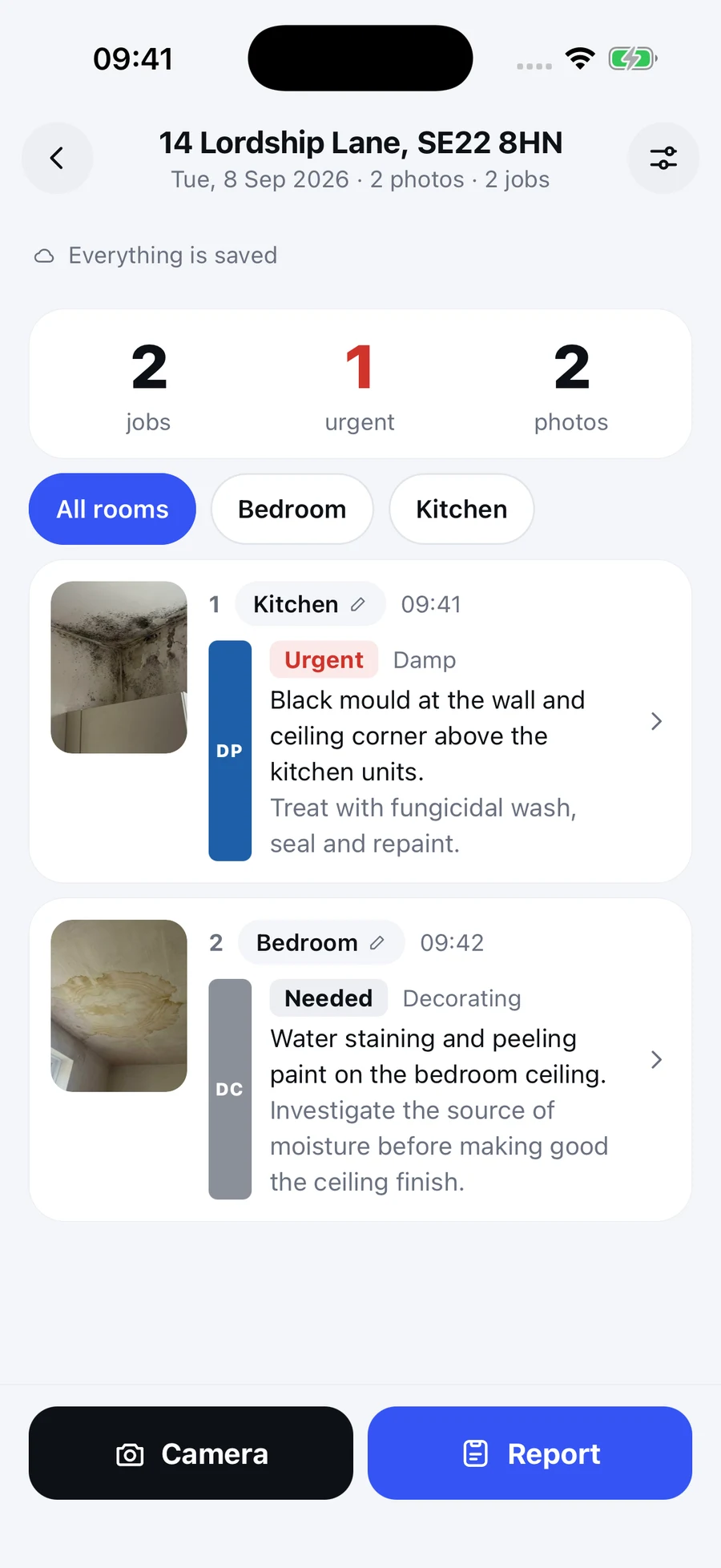
Actual iPhone app. Demonstration visit.
What a snagging list actually is
It is not a complaint and it is not a wish list. It is a dated, written, photographed record of the things a builder did not finish or did not build to standard: the document you rely on when you need someone to come back.
One defect, one line
Every entry names one fault in one place. A line that says ‘kitchen needs finishing’ gets argued with. ‘Kitchen: cupboard door under the sink does not close flush’ gets fixed.
A photograph each
The photo is the evidence. Close enough to show the defect, wide enough to show where in the room it is. Marking it on the picture removes the last argument about which crack you meant.
Grouped by room
The builder walks the house room by room and so does the list. Anything else means the joiner visits the same landing four times.
Your rights, and the clock that is running
Snagging is not goodwill. Two separate protections sit behind the list, and both have dates on them.
The two year builder period
Under an NHBC Buildmark warranty the first two years after legal completion are the builder warranty period: the developer is responsible for putting right defects caused by their failure to build to NHBC standards. From year three to year ten the cover becomes insurance against specified structural defects, and cosmetic snagging is no longer part of it. NHBC also runs a free resolution service during those first two years.
Your pre-completion inspection
If your developer is registered with the New Homes Quality Board, the New Homes Quality Code gives you the right to a pre-completion inspection. Version 2 of the Code, published March 2026, keeps your right to appoint a professional and adds the option of doing the inspection yourself using the NHQB checklist. Where what you find breaches warranty technical standards, the developer is responsible for addressing it, ideally before legal completion or within 30 days where that is not possible.
That second change is the one worth reading twice. You are allowed to inspect your own home. What has always been missing is a way to do it that produces something a site manager takes as seriously as a surveyor’s report. That is the gap this app was built for.
The room by room checks
Work one room at a time and finish it before you move. Photograph as you go: a defect you meant to come back to is a defect that never makes the list.
Every room, before anything else
- Walls: dents, roller marks, patches showing through, filler left unpainted
- Ceilings: cracks at the joints, shadowing, uneven emulsion
- Skirting and architrave: gaps at the mitres, nail holes unfilled, paint on the carpet
- Sockets and switches: level, tight to the wall, working, matching height
- Doors: closing without catching, handles aligned, hinges not proud
- Windows: opening, locking, sealed, no scratches on the glass
- Floor: level, no lifting boards, no gaps at the edge
- Radiators: level, brackets tight, valves not weeping
Kitchen
- Cupboard doors aligned and closing flush, all at the same gap
- Worktop joints tight and sealed, no chips at the sink cut-out
- Appliances present, working, and the ones you paid for
- Extractor venting outside, not into a void
- Tiling and splashback level, grout clean, silicone unbroken
- Under the sink: no drips at the trap after running water for a minute
Bathrooms and en-suites
- Silicone continuous around bath, basin and tray, no mould already
- Shower running hot, draining fast, screen sealed
- Toilet flushing and refilling cleanly, seat aligned
- Extractor pulling: hold a sheet of tissue to it
- Tiles flat, cuts neat at the corners, no hollow ones when tapped
- Towel rail hot and level
Outside and the loft
- Render and brickwork: cracks, mortar snots, stained bricks
- Gutters and downpipes clipped, falling the right way
- Drives and paths: ponding water, loose slabs, edging
- Fencing and gates square, latching, posts firm
- Loft insulation even and to depth, not pushed aside
- Loft hatch sealed, no daylight at the eaves
How to do it in one walk
The reason most snagging lists are thin is not that people miss things. It is that writing them up afterwards is miserable, so it happens days later from memory and a camera roll.
- 1
Type the address and start walking
No project to set up, no template to choose, no rooms to configure. The first thing you do in the app is take a photo.
- 2
Photograph the defect and circle it
Draw on the photo with your finger. The circle is what stops a site manager asking which mark on the wall you meant.
- 3
Hold the button and say what is wrong
Talk the way you would to the person standing next to you. ‘Second bedroom, hairline crack above the window, full width.’ It becomes a written job line.
- 4
Say the room once, then keep going
Name a room and everything after it is filed there until you name another. You never stop to categorise anything.
- 5
Send the report before you leave the drive
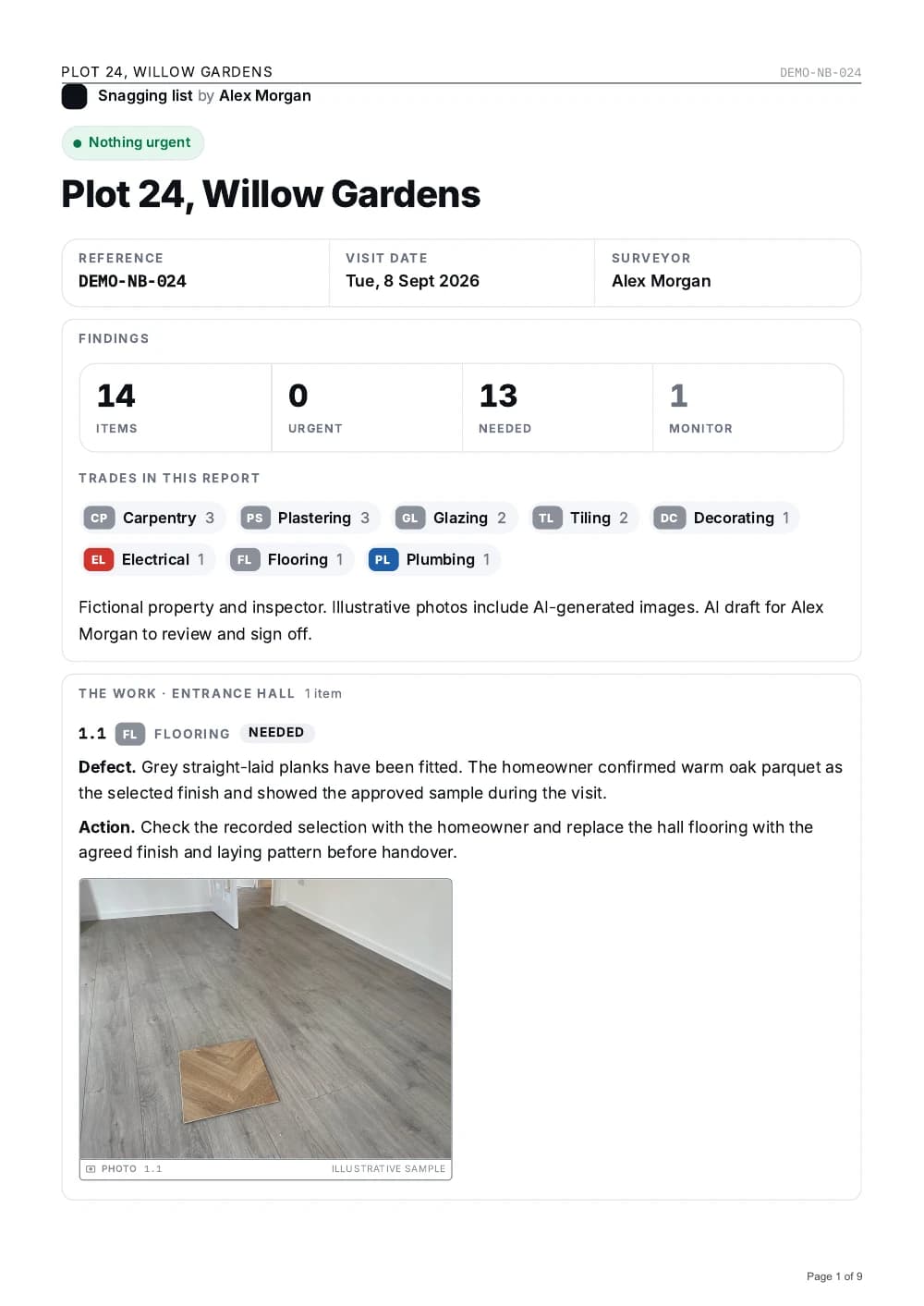
A PDF grouped by room, with your photos and your circles, signed off in your name. Send it to the builder from your phone.
What the finished list looks like
This is the document the app produces. Every line comes from a photo and a spoken sentence on site, and nothing is typed up afterwards. What a scope of works has to contain.
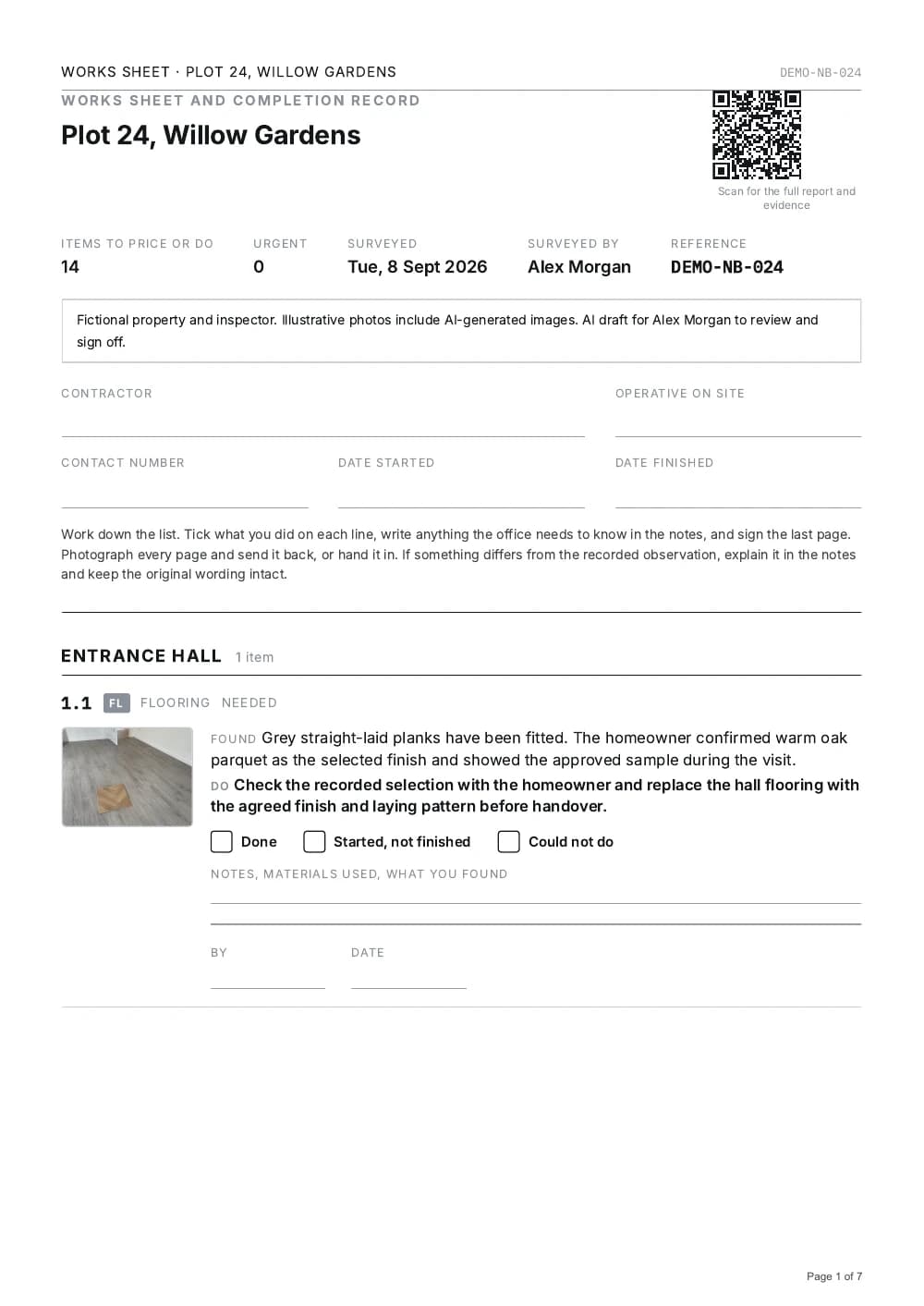
For the contractor
Works sheet
The same 14 numbered snags. Print it for notes, materials used and completion.
Open the 7-page works sheetQuestions people ask
What is a snagging list?
A snagging list is the written record of every defect and unfinished item in a new build home. Each entry names one fault in one place, backed by a photograph, and the list is normally grouped by room so the builder can work through it in the order they walk the house.
When should I do the snagging list?
As early as you are allowed in. If your developer is registered with the New Homes Quality Board you have a right to a pre-completion inspection, and defects that breach warranty technical standards are the developer’s responsibility to address, ideally before legal completion. After you move in, the builder warranty period under an NHBC Buildmark policy runs for two years from legal completion.
Can I do my own snagging list or do I need a surveyor?
You can do your own. Version 2 of the New Homes Quality Code, published in March 2026, explicitly gives buyers the option of carrying out the pre-completion inspection themselves using the NHQB checklist, alongside the existing right to appoint a professional. A professional snagging survey typically costs between £300 and £600 depending on the size of the property.
How many items should be on a snagging list?
There is no target number and padding a list weakens it. Record what is genuinely wrong, describe each item precisely, and photograph it. A short list of well evidenced defects gets acted on faster than a long list of opinions.
What happens if the builder ignores the list?
Send the list in writing and keep the dated copy with its photographs, because that record is what any escalation rests on. Under an NHBC Buildmark policy the free NHBC resolution service is available during the first two years, and developers registered with the New Homes Quality Board are also within reach of the New Homes Ombudsman.
Walk the house once. Leave with the list.
Try your first visit free: the iPhone app from the App Store, or your browser. Capture photos and notes on site, then connect to review the AI draft and share your report.
One free report a week · Up to 10 jobs · No card