The twelve months
after handover.
The defects liability period is the window after practical completion in which the contractor has to come back and put right defects in the works, at their own cost. JCT contracts call it the rectification period. It is normally twelve months, and it is where the second half of the retention is sitting.
One free report a week · Up to 10 jobs · No card
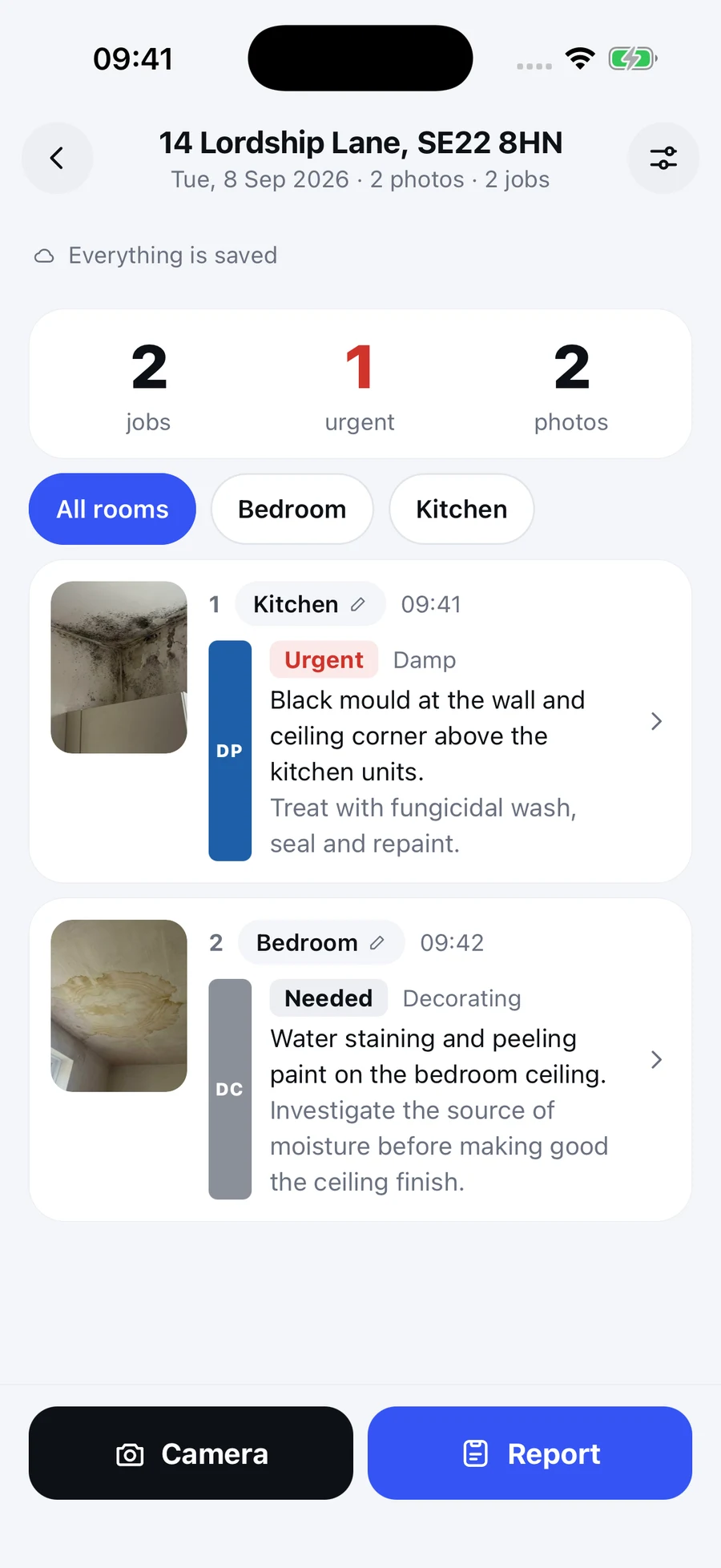
Actual iPhone app. Demonstration visit.
The one paragraph answer
The defects liability period begins on certification of practical completion and typically runs for six to twelve months, with twelve months being usual under most JCT forms. During it, defects that are the contractor’s responsibility are notified to them and they return and make them good at no cost to the employer. At the end of the period the contract administrator issues a schedule of defects, and once those are remedied a certificate of making good, which is normally what releases the remaining retention.
It is not a warranty and it is not the limit of the contractor’s liability. It is a practical mechanism: a defined window with a right of access, so that faults get fixed by the people who built the thing rather than argued about afterwards. Liability for defective work can continue well beyond it under the general law of contract.
The four moments that matter
Almost every dispute in this period comes down to one of these four being undocumented.
Practical completion
The clock starts here. Whatever the condition of the works on this date is the baseline for everything that follows, which is why a photographed record taken at handover is worth more than any other document in the file.
Defects notified during the period
Each one needs a date, a location and a description. A defect reported by text message on a Sunday exists in nobody’s record by month nine.
The schedule of defects at the end
Under JCT SBC/Q the contract administrator issues a schedule of defects after the rectification period ends. It is the consolidated list, and it is only as complete as what was captured along the way.
The certificate of making good
Issued once the scheduled defects are remedied. In the JCT 2016 suite it is the certificate of making good, and it is typically what triggers release of the second half of the retention.
Terminology and procedure vary by contract. Check the one you are on. Background reading: RICS practice information, Defects and Rectifications, 2nd edition.
Where the money actually is
Retention is usually held at a percentage of the contract sum, released in two halves: one at practical completion, one after making good. The second half is the part that goes missing.
For the contractor
Every defect you closed and cannot prove you closed is a reason for the second half of the retention to sit unreleased. A dated, photographed record of the remedial visit ends that argument in one message.
For the employer
Defects that were never written down are defects you will pay to fix yourself. The value of the period is entirely in what was notified inside it.
For the contract administrator
The schedule of defects at the end is a compilation exercise. If the year’s visits were recorded consistently, it is an afternoon. If they were not, it is a re-inspection.
Recording a defects visit
- 1
One visit, one record, per attendance
Type the address and start. Every photograph, clip and note from that attendance belongs to that dated visit, so the history of the property builds itself across the period.
- 2
Name the area as you enter it
Say it out loud while walking. Plot 14 landing, second floor riser, unit 3 WC. Nothing ends up as a photograph nobody can place.
- 3
Photograph the defect and circle it
Mark it with your finger on the picture. It removes the whole class of argument about which crack, which tile, which panel.
- 4
Say what is wrong and what has to happen
Hold the button and talk. It comes back as the written defect line with the trade and the urgency attached, so the list can be issued to the subcontractors who will actually attend.
- 5
Send it before you leave
An A4 PDF or a share link, grouped by area and by trade, signed off in the name of the person who inspected. Dated on the day, not written up a week later.
Related
For defects in a new home rather than under a building contract, read what snagging means. For the lease equivalent at the end of a commercial tenancy, read dilapidations. For the full list of inspections this covers, see use cases.
Defects liability questions
What is the defects liability period?
The defects liability period is the period following practical completion during which the contractor is obliged to return and make good defects in the works at their own cost. JCT contracts call it the rectification period.
How long is the defects liability period?
It typically runs for six to twelve months from certification of practical completion, and twelve months is usual under most JCT forms. The exact length is whatever the particular contract states.
Is the defects liability period the same as the rectification period?
Yes. Rectification period is the term JCT contracts use for what the industry has long called the defects liability period. NEC contracts use different terms again, with a defects date and a defect correction period.
Who pays to fix a defect during the period?
The contractor, where the defect is one they are responsible for under the contract. That is the point of the mechanism: the employer is not expected to pay twice for work that was not done properly the first time.
Does liability end when the period ends?
No. The end of the defects liability period ends the contractor’s right and obligation to return and remedy under that mechanism. Liability for defective work can continue afterwards under the general law of contract, subject to the applicable limitation period.
What releases the second half of the retention?
Normally the certificate of making good, issued once the defects listed in the schedule of defects have been remedied. In the JCT 2016 suite it is called the certificate of making good.
Twelve months of visits, all written down
Photograph each defect, say what is wrong, send it from the doorstep. Unlimited visits free, and one report a week goes out free.
One free report a week · Up to 10 jobs · No card