Dilapidations
stand on evidence.
Dilapidations are breaches of a tenant’s lease obligations about the condition of the property. Every one of them has to be located, described and photographed before it is worth anything in a schedule. That part happens on the walk, and the walk is the part that goes wrong.
One free report a week · Up to 10 jobs · No card
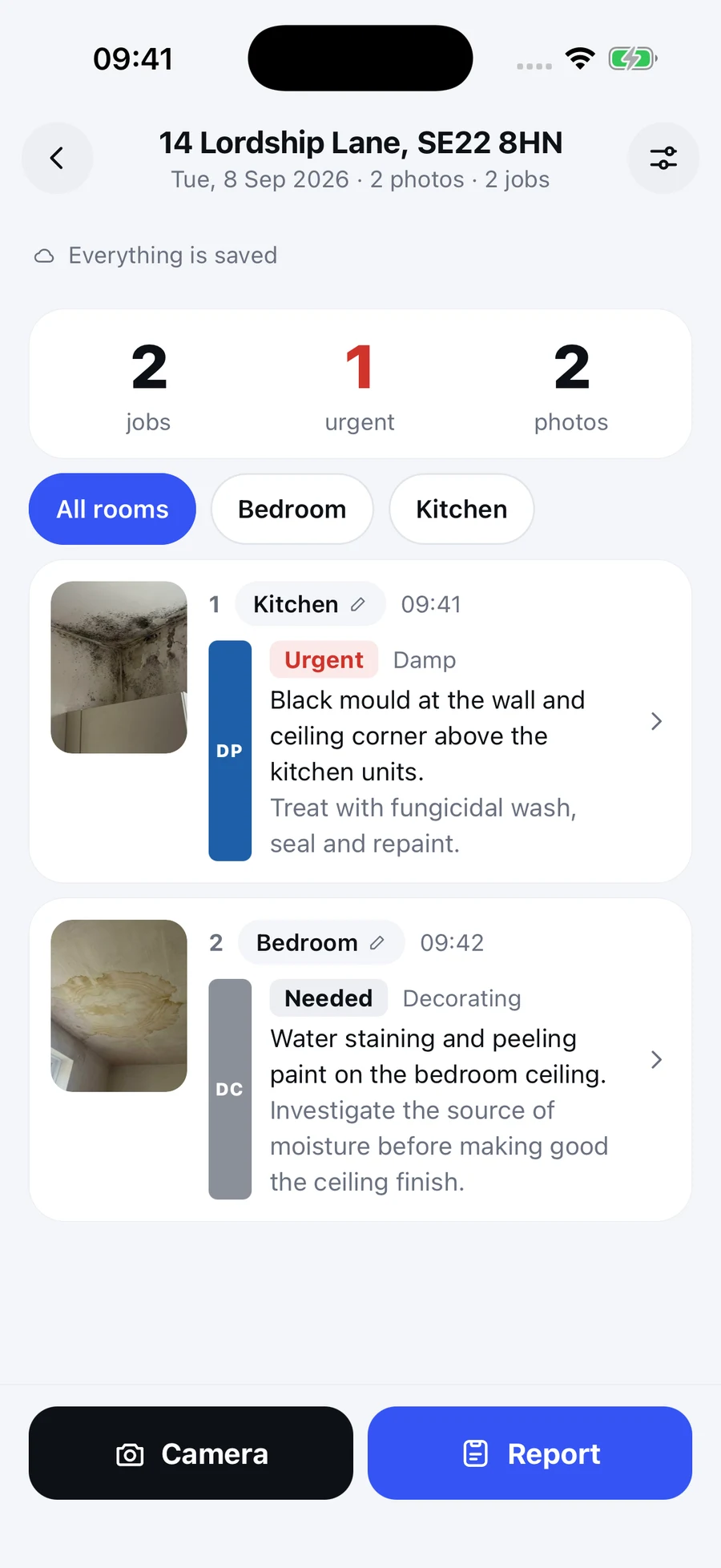
Actual iPhone app. Demonstration visit.
The one paragraph answer
Dilapidations is the term for a tenant’s failure to meet the repair, decoration and reinstatement obligations in a commercial lease. The claim is set out in a schedule of dilapidations: a list in which each item names one breach, the lease clause it breaches, the remedial work required and what the landlord says it costs. Interim schedules are served during the term; terminal schedules at or after the end of it. The amount recoverable is capped by section 18(1) of the Landlord and Tenant Act 1927 at the diminution in the value of the landlord’s reversion.
SayScope does not write the schedule and does not price it. That is the surveyor’s work, and it needs the lease. What SayScope does is the layer underneath: it turns the walk into a photographed, located, described record of every item of disrepair, so the person drafting the schedule is working from evidence instead of from a camera roll and a memory of a Tuesday.
What the Protocol actually requires
Claims for terminal dilapidations on commercial property in England and Wales sit under a pre-action protocol that has been part of the Civil Procedure Rules since 1 January 2012. It is specific about the shape of the document.
Five columns, per Annexes B and C
Item number, the lease clause, the breach complained of, the remedial works required, and the landlord’s costings. An item that cannot fill all five is not yet an item.
Breaches separated into categories, per paragraph 3.2
Repair, reinstatement, redecoration and so on. The categories are how the schedule is read and how it is argued, so they have to be decided item by item rather than at the end.
Generally within 56 days of termination, per paragraph 3.3
The schedule should be sent within a reasonable time, which the Protocol says will generally be within 56 days after the tenancy ends. Paragraph 3.4 allows service before termination, with confirmation or an updated schedule once it ends.
A formal diminution valuation where it applies, per section 9
Quantifying the loss is a separate exercise from listing the breaches, and the Protocol treats it that way.
Source: Pre-Action Protocol for Claims for Damages in Relation to the Physical State of Commercial Property at Termination of a Tenancy (the Dilapidations Protocol), and section 18, Landlord and Tenant Act 1927. The Protocol applies to commercial property in England and Wales.
Interim, terminal, and the schedule of condition
Three documents, constantly confused, doing three different jobs.
Schedule of condition
A record of how the property stood at the start of the lease, usually annexed to it. It is the tenant’s protection: you cannot be asked to hand back something better than you were given. Photographs dated at the start are the whole point of it.
Interim schedule
Served during the term, while there is still time to put the work right. The remedy is the work itself, done by the tenant, rather than a sum of money at the end.
Terminal schedule
Served at or after the end of the tenancy, generally within 56 days. By this point the tenant has usually gone, so the schedule is a claim in money and it lives entirely on the evidence recorded at the inspection.
The pattern worth noticing: two of the three are won or lost by photographs taken on a specific date, by a named person, tied to a named part of the building. A schedule of condition with vague pictures is worth very little five years later, and a terminal schedule with no photograph of an item invites the answer that it was like that when the tenant moved in.
How the walk goes with SayScope
- 1
Type the address, start the visit
No project to set up, no template to choose, no account to start. One property, one walk, one record.
- 2
Name each area out loud as you enter it
Reception, first floor office, plant room, external. The area name attaches to everything you capture from then on, so nothing ends up as an unplaceable photograph.
- 3
Photograph the breach and circle it
Mark the picture with your finger. A photograph of a wall is ambiguous; a photograph of a wall with the damage circled is not.
- 4
Hold the button and say what is wrong
Speak like a voice note: what the item is, what has happened, what has to be done. It comes back as the written line carrying the trade and the urgency.
- 5
Leave with it written
An A4 PDF and a share link, grouped by area for the walk and by trade for the pricing, every item photographed and marked, signed off in your name.
What you take to the drafting desk is a complete, ordered, evidenced list of items. Clause numbers and costings you add from the lease, which is where they have to come from.
Related
Dilapidations is one of ten inspections that are the same walk. If the output you need is priceable work rather than a claim, read scope of works. For defects during a building contract rather than a lease, read the defects liability period.
Dilapidations questions
What are dilapidations?
Dilapidations are breaches of the obligations in a commercial lease about the condition of the property: typically the covenants to repair, to decorate and to reinstate alterations. The landlord’s claim in respect of those breaches is set out in a schedule of dilapidations.
What must a schedule of dilapidations contain?
Under the Dilapidations Protocol the schedule is set out in five columns, per its Annexes B and C: the item number, the lease clause, the breach complained of, the remedial works required, and the landlord’s costings. Paragraph 3.2 requires the breaches to be separated into categories such as repair, reinstatement and redecoration.
How long after the lease ends can a schedule be served?
Paragraph 3.3 of the Protocol says the schedule should be sent within a reasonable time, which will generally be within 56 days after the termination of the tenancy. Paragraph 3.4 allows a schedule to be served before termination, provided it is confirmed or updated once the tenancy ends.
What is the difference between an interim and a terminal schedule?
An interim schedule is served during the lease term, while the tenant still has time to carry out the work. A terminal schedule is served at or after the end of the tenancy, when the remedy is normally money rather than work.
Is there a cap on what a landlord can recover?
Yes. Section 18(1) of the Landlord and Tenant Act 1927 provides that damages for breach of a covenant to keep or put premises in repair shall in no case exceed the amount by which the value of the reversion is diminished owing to the breach.
Does SayScope produce a schedule of dilapidations?
No. SayScope records the inspection: every item of disrepair photographed, marked, located in a named area and described in your own spoken words, grouped by area and by trade. The schedule itself, with its lease clauses and costings, is drafted from that record by the surveyor, because it depends on the lease.
Get the evidence right on the day
Photograph each breach, circle it, say what is wrong. Leave with the record already written. Unlimited visits free, and one report a week goes out free.
One free report a week · Up to 10 jobs · No card